What Is Object Tracking in Computer Vision?
On this page
- What Is Object Tracking?
- Object Detection vs. Object Tracking: What's the Difference?
- How Does Object Tracking Work?
- Types of Object Tracking in Computer Vision
- Common Object Tracking Algorithms
- Real-World Applications of Object Tracking
- Challenges and Limitations of Object Tracking
- How Is Object Tracking Accuracy Measured?
- How to Choose an Object Tracking Solution
- Object Tracking and Intelligent Video Analytics
- Frequently Asked Questions About Object Tracking
- Conclusion
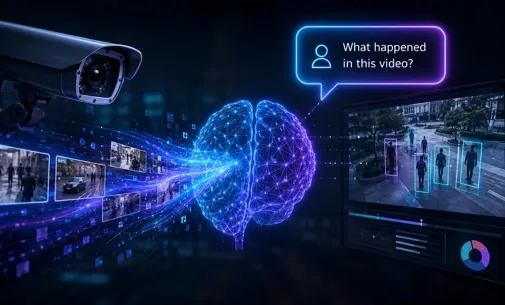
Object tracking in computer vision is the process of identifying and following an object as it moves through a sequence of images or video frames. Unlike object detection, which identifies objects in individual frames, object tracking maintains their identities over time, allowing AI systems to understand where objects move, how their positions change, and how they interact with their surroundings.
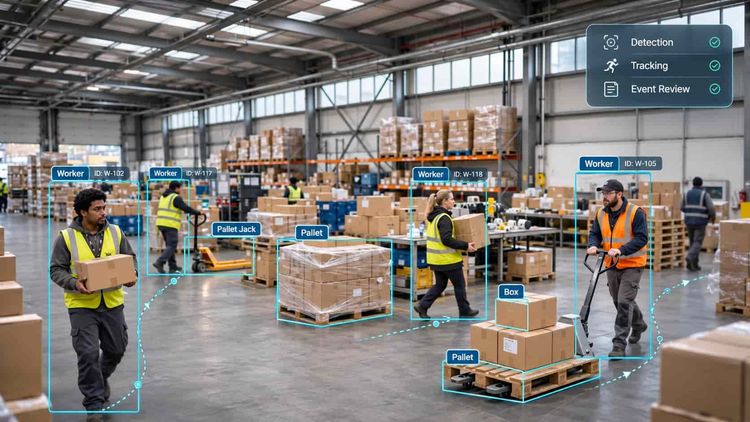
For example, imagine a warehouse camera recording several workers and forklifts. Object detection can identify each person and vehicle in a frame. Object tracking goes further by assigning consistent IDs to those objects and following their movement throughout the video.
This ability makes object tracking an important component of intelligent video analytics, autonomous vehicles, robotics, security monitoring, and industrial automation.
What Is Object Tracking?
Object tracking is a computer vision technique that estimates the location of one or more objects across successive frames of a video.
A tracking system typically maintains information such as:
Object identity: A unique tracking ID assigned to an object.
Object position: The object's estimated location within each frame.
Object trajectory: The sequence of positions the object occupies over time.
Movement: Changes in position, direction, or estimated speed.
Tracking status: Whether an object is currently visible, temporarily missing, or no longer being tracked.
Consider a video containing three people walking through a building. A tracking system might assign them the identifiers Person 1, Person 2, and Person 3.
As the people move, the system attempts to preserve those identifiers instead of treating each appearance as a completely new person.
This is called identity association, and it is one of the central challenges in multi-object tracking.
A tracking ID does not necessarily identify a person's real-world identity. It is generally a temporary identifier used to associate observations within a tracking sequence.
Why Is Object Tracking Important?
A single image can tell us what objects are present at a particular moment. A sequence of tracked objects can provide information about movement and behavior over time.
Object tracking helps video analysis systems answer questions such as:
How many objects moved through a particular area?
Which direction did an object travel?
How long did an object remain in a region?
Did two tracked objects move close to each other?
Did an object enter or leave a monitored zone?
What path did an object follow?
These capabilities allow video analysis systems to move beyond identifying objects toward understanding activities and events.
However, tracking alone does not explain every event or intention. More advanced analysis may require additional models, contextual rules, or human review.
Object Detection vs. Object Tracking: What's the Difference?
Object detection and object tracking are closely related computer vision techniques, but they solve different problems.
Object detection identifies and locates objects within an image or video frame. It typically produces bounding boxes, class labels, and confidence scores.
Object tracking connects observations across frames to estimate which objects correspond to the same physical targets over time.
| Feature | Object Detection | Object Tracking |
|---|---|---|
| Main purpose | Identify and locate objects | Follow objects over time |
| Input | Images or video frames | A sequence of frames or observations |
| Typical output | Bounding boxes and class labels | Object IDs, positions, and trajectories |
| Temporal information | Not necessarily required | Essential |
| Identity consistency | Not maintained by detection alone | Attempts to maintain consistent IDs |
| Example | Detecting a forklift in a frame | Following the forklift across a video |
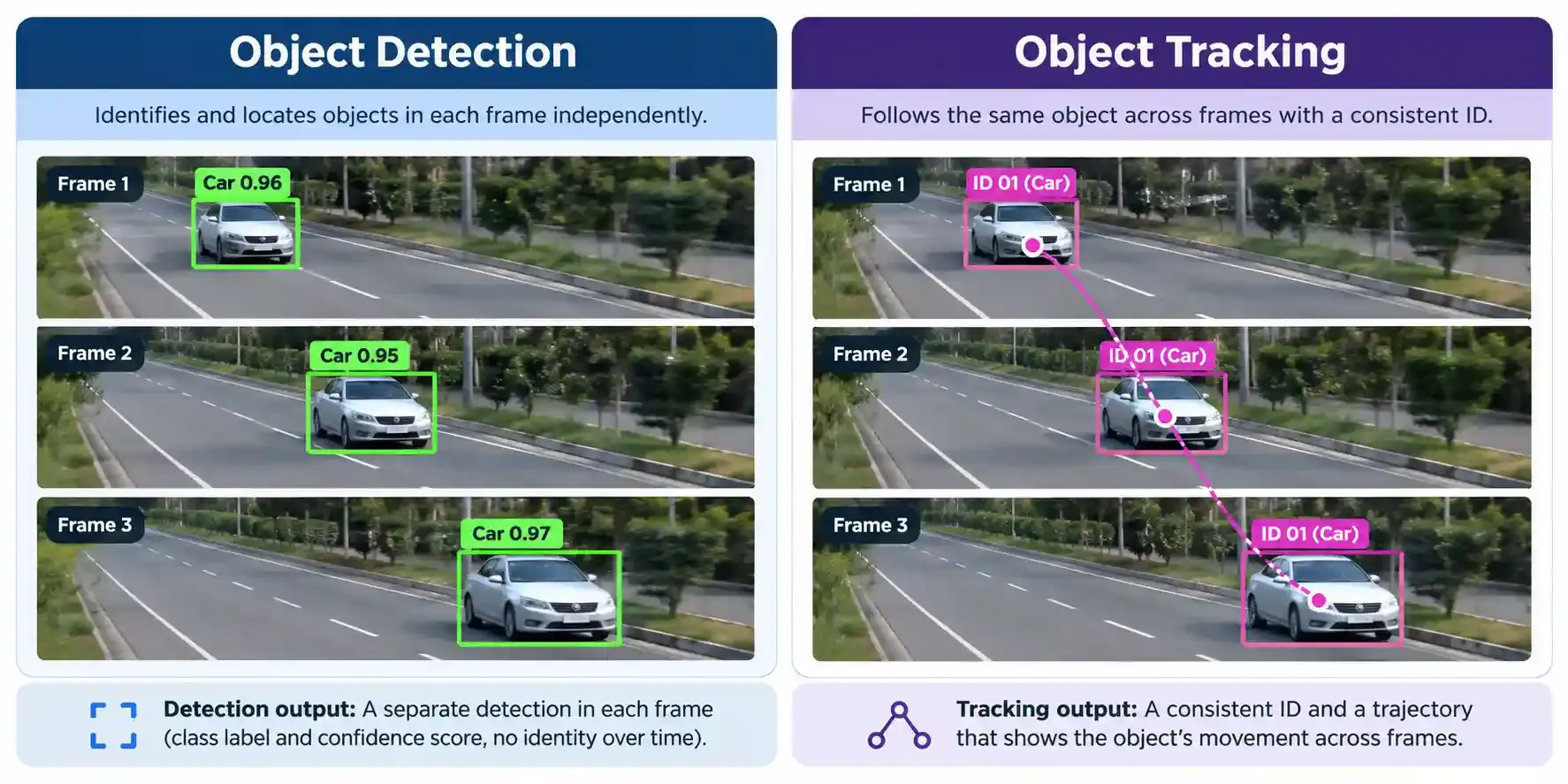
Example: Tracking a Moving Vehicle
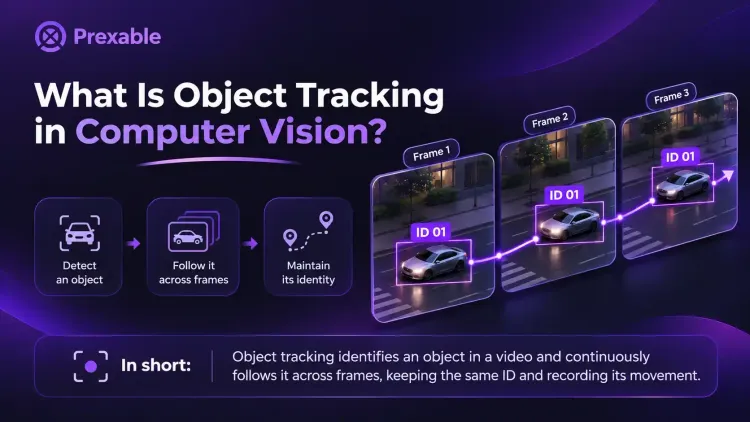
Imagine a vehicle moving through three consecutive video frames.
With object detection, the system identifies a vehicle in each frame. However, these detections do not automatically establish whether the vehicle is the same one.
With object tracking, the system associates those detections and attempts to maintain a consistent identifier, such as Vehicle 1.
The resulting sequence of positions forms a trajectory that can be used for further analysis.
Can Object Tracking Work Without Object Detection?
Yes. Not every tracking system requires a separate object detector.
Some single-object tracking approaches begin with a manually or automatically selected target and estimate its location in subsequent frames.
Other approaches, especially tracking-by-detection systems, use an object detector to identify potential targets and a tracking algorithm to associate those detections across frames.
The appropriate approach depends on the application, available data, and tracking requirements.
How Does Object Tracking Work?
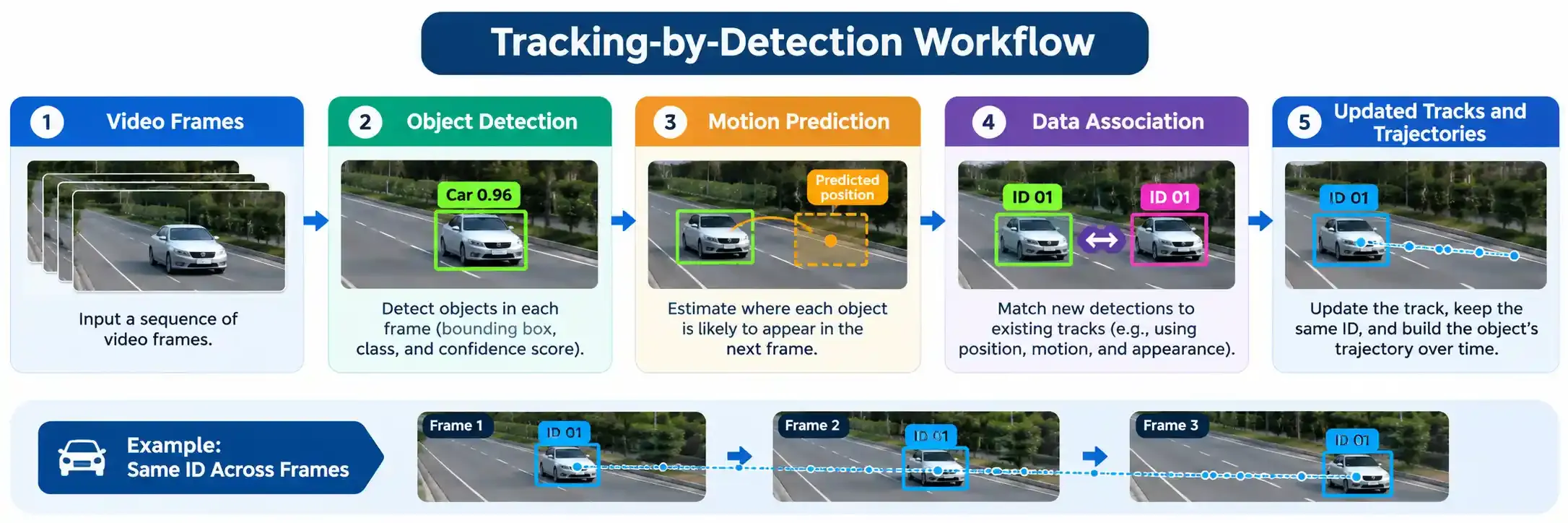
Many modern multi-object tracking systems follow a tracking-by-detection workflow.
In this approach, a computer vision model detects objects in video frames, and a tracking algorithm determines which detections belong to previously observed objects.
Although implementations differ, a typical workflow includes five stages.
1. Object Detection or Target Initialization
The system first identifies objects that need to be tracked.
A detector may locate people, vehicles, animals, or other relevant objects within a video frame.
For example, a warehouse video analysis system might detect three workers and two forklifts.
Each detection may include a bounding box, object class, and confidence score.
In single-object tracking, the process may instead begin with a selected target.
2. Motion Prediction
The tracking algorithm estimates where an existing object is likely to appear in the next frame.
Some trackers use mathematical motion models, such as a Kalman filter, to predict object positions based on previous observations.
Motion prediction helps the system maintain continuity when objects move between frames or when a detection is temporarily unavailable.
However, predictions can become less reliable when objects change direction unexpectedly or remain hidden for extended periods.
3. Data Association
Data association is the process of matching new observations to existing tracks.
For example, if a system is tracking five people, it must determine which newly detected person corresponds to each previously assigned ID.
Tracking algorithms may compare:
Predicted and observed positions
Bounding box overlap
Object appearance features
Motion patterns
Detection confidence scores
The association method depends on the tracking algorithm.
Incorrect associations can cause identity switches, where a tracker assigns one object's ID to another object.
4. Track Updating and Identity Management
After matching detections to existing tracks, the system updates each object's estimated position and tracking information.
New objects may receive new IDs, while existing objects retain their IDs when the association is successful.
If an object temporarily disappears, the system may keep its track active for a limited number of frames.
Different trackers use different rules to determine when to create, maintain, or remove tracks.
5. Trajectory Generation
As tracking continues, the system collects a sequence of estimated object positions.
These positions form a trajectory representing the object's movement through the video.
Trajectory information can support applications such as:
Movement analysis
Object counting
Route monitoring
Zone entry and exit detection
Traffic analysis
Activity analysis
Additional processing may be required to turn trajectories into meaningful business events.
Types of Object Tracking in Computer Vision
Object tracking methods can be classified in several ways, including the number of objects being tracked and how the tracking process is performed.
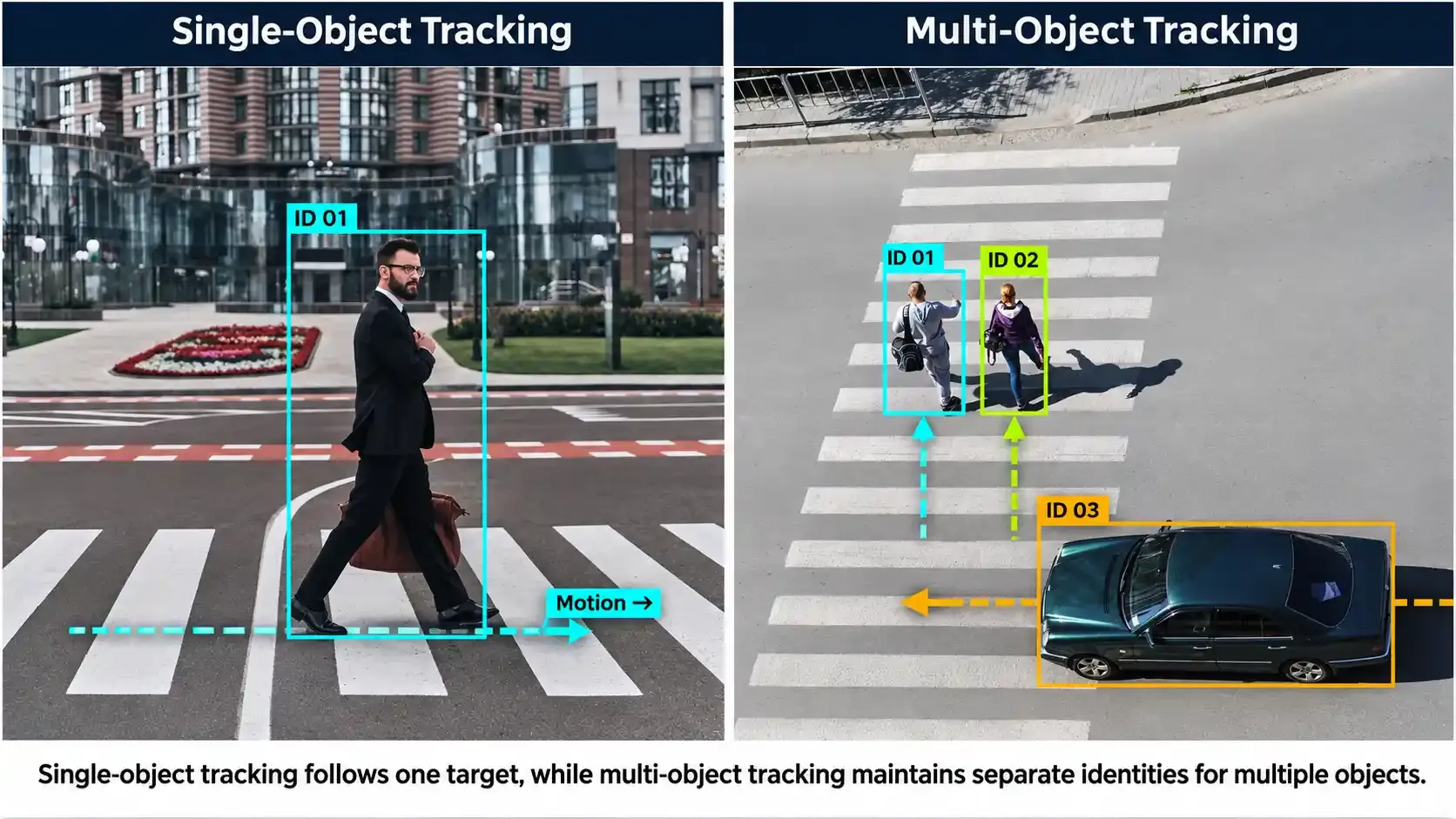
Two important categories are single-object tracking and multi-object tracking.
Single-Object Tracking (SOT)
Single-object tracking focuses on following one selected target through a video sequence.
The target is typically initialized in an early frame, and the tracker estimates its position in subsequent frames.
For example, a tracking system might follow one vehicle moving through a traffic scene.
Single-object tracking is commonly studied in applications involving robotics, video analysis, and visual navigation.
Its main challenges include changes in target appearance, rapid movement, occlusion, and background distractions.
Multi-Object Tracking (MOT)
Multi-object tracking follows several objects simultaneously while attempting to maintain a consistent identity for each one.
For example, a camera monitoring a warehouse may observe multiple workers and forklifts moving through the same area.
A multi-object tracking system must distinguish between those objects, associate their observations across frames, and manage objects entering or leaving the scene.
Multi-object tracking is generally more complex than tracking a single target because objects may overlap, look similar, or move close together.
Online vs. Offline Object Tracking
Another distinction concerns when tracking information is processed.
Online tracking processes frames sequentially, using information available up to the current frame. This approach is suitable for applications that require results during video processing.
Offline tracking can analyze an entire recorded sequence, potentially using both earlier and later frames to improve associations.
Offline methods may be useful when immediate results are unnecessary and a complete recording is available.
The distinction does not guarantee that one approach will always be more accurate or efficient. Performance depends on the specific implementation and conditions.
Common Object Tracking Algorithms
Computer vision researchers have developed numerous tracking algorithms to address motion prediction, identity association, and appearance changes.
Different methods offer different trade-offs between accuracy, computational requirements, and implementation complexity.
Kalman Filter
A Kalman filter is a mathematical estimation method used to predict and update the state of a moving object.
In object tracking, it can estimate an object's position and motion using previous observations.
Kalman filters are commonly used as components of tracking systems rather than complete visual tracking solutions on their own.
Their effectiveness depends on the motion model and the quality of the observations.
SORT (Simple Online and Realtime Tracking)
SORT is a multi-object tracking approach that combines object detections with motion estimation and data association.
Its original formulation uses Kalman filtering for motion prediction and the Hungarian algorithm for matching detections to tracks.
SORT is relatively simple and computationally efficient, making it an important baseline in multi-object tracking research.
However, relying primarily on motion and geometric information can make identity association difficult during extended occlusions or complex interactions.
DeepSORT
DeepSORT extends SORT by incorporating deep appearance features into the data association process.
These features help the tracker compare the visual appearance of objects when deciding whether new detections belong to existing tracks.
Appearance information can help reduce identity switches, particularly when motion information alone is insufficient.
However, its effectiveness still depends on the quality of the appearance features and the conditions of the video.
ByteTrack
ByteTrack is a multi-object tracking method designed to improve association by considering detections with different confidence scores.
Instead of discarding all low-confidence detections immediately, ByteTrack uses an association strategy that can recover objects whose detections have become less confident.
This can be useful when objects are partially occluded or difficult to detect.
ByteTrack's performance still depends on the detector, scene conditions, and implementation settings.
BoT-SORT
BoT-SORT is a multi-object tracking approach that combines motion and appearance information with techniques such as camera-motion compensation.
It is designed to improve tracking robustness in challenging scenes, including situations involving camera movement.
Like other trackers, its suitability depends on the application, available computing resources, and evaluation results.
Comparison of Object Tracking Approaches
| Algorithm | Main approach | Notable characteristic |
|---|---|---|
| Kalman filter | State estimation | Predicts and updates motion estimates |
| SORT | Motion-based tracking by detection | Simple online tracking baseline |
| DeepSORT | Motion and appearance association | Uses visual features to support identity matching |
| ByteTrack | Detection-score-aware association | Associates detections across confidence levels |
| BoT-SORT | Motion, appearance, and camera-motion handling | Addresses challenging multi-object tracking conditions |
There is no universally best object tracking algorithm.
The appropriate choice depends on the number and type of objects, camera conditions, processing requirements, and importance of maintaining identities.
For technical details, see the original research on SORT, DeepSORT, ByteTrack, and BoT-SORT.
Real-World Applications of Object Tracking
Object tracking is used in many industries where understanding movement is important.
The information produced by tracking can support monitoring, automation, operational analysis, and decision-making.
1. Warehouse and Industrial Monitoring
Warehouses and industrial facilities often contain moving equipment, workers, and materials.
Computer vision tracking can help analyze how these objects move through monitored areas.
Potential applications include:
Tracking forklift movement through warehouse aisles.
Monitoring pedestrian movement in shared workspaces.
Analyzing equipment movement patterns.
Counting objects passing through designated zones.
Studying traffic flow in busy operational areas.
For example, tracking forklift and pedestrian positions may provide information for analyzing how often their paths intersect.
However, reliable safety alerts require additional proximity analysis, camera calibration, appropriate system validation, and operational safeguards. Object tracking alone should not be treated as a certified safety system.
2. Security and Video Surveillance
Security systems can use object tracking to follow people or vehicles through recorded or live camera footage.
Potential applications include monitoring movement through restricted areas, analyzing activity patterns, and supporting investigations.
Tracking can also help identify when an object enters or exits a defined region.
Cross-camera tracking is more complex because the system must associate objects observed by different cameras, potentially under different lighting conditions and viewing angles.
3. Traffic and Transportation
Traffic analysis systems can use object tracking to study vehicle and pedestrian movement.
Applications include:
Vehicle counting
Traffic flow analysis
Pedestrian movement analysis
Intersection monitoring
Vehicle trajectory estimation
Tracking results can help transportation researchers and planners understand movement patterns.
4. Retail and Customer-Flow Analytics
Retail environments can use object tracking to study movement patterns within stores.
For example, a system may estimate how visitors move between areas, where congestion occurs, or how long people remain in specific zones.
These applications require appropriate privacy protections and compliance with applicable laws.
5. Robotics and Autonomous Systems
Robots and autonomous systems may use object tracking to estimate how nearby objects move.
This information can contribute to navigation, obstacle avoidance, and motion planning.
For example, a mobile robot may need to distinguish between stationary obstacles and moving people.
Tracking is only one component of such systems. Reliable autonomous operation also depends on perception, planning, control, and other safety mechanisms.
6. Sports and Motion Analysis
Object tracking can help analyze the movement of players, balls, and equipment in sports footage.
Applications include estimating player trajectories, analyzing movement patterns, and supporting performance analysis.
The reliability of these results depends on factors such as camera placement, image quality, object visibility, and the tracking method.
Challenges and Limitations of Object Tracking
Although object tracking has advanced significantly, maintaining accurate object identities remains difficult in complex environments.
Understanding these limitations is important when selecting or evaluating a tracking system.
Occlusion
Occlusion occurs when an object becomes partially or completely hidden behind another object or obstacle.
For example, a pedestrian may temporarily disappear behind a forklift.
A tracking system must determine whether the pedestrian reappearing later is the same previously tracked person.
Long occlusions can make this association particularly difficult.
Identity Switches
An identity switch occurs when a tracking system incorrectly changes the identity assigned to an object.
For example, two pedestrians may cross paths, causing the system to exchange their tracking IDs.
Identity switches can affect trajectory analysis, object counting, and other downstream applications.
Similar-Looking Objects
Tracking several visually similar objects can be challenging.
Workers wearing similar uniforms or vehicles with similar appearances may be difficult to distinguish using visual features alone.
Tracking systems may need to combine appearance information with motion and spatial relationships.
Lighting and Image Quality
Low lighting, shadows, motion blur, and poor video resolution can reduce the quality of object detections and tracking associations.
The effect depends on the tracking algorithm and the conditions under which the system operates.
Camera Movement
A moving camera changes the apparent positions of objects even when those objects are stationary.
Some tracking approaches use camera-motion compensation to account for this effect.
Crowded Scenes
Crowded environments create additional challenges because objects frequently overlap or move close together.
These conditions increase the difficulty of maintaining consistent identities.
Processing Requirements
Tracking systems may need to process many frames and objects within limited computing resources.
Higher video resolutions, more complex models, and larger numbers of tracked objects can increase computational demands.
The appropriate balance between accuracy, processing speed, and resource usage depends on the application.
How Is Object Tracking Accuracy Measured?
Evaluating an object tracking system requires more than checking whether objects are detected correctly.
A tracking system must also maintain identities and estimate object positions consistently over time.
Several metrics are commonly used in multi-object tracking research.
Multiple Object Tracking Accuracy (MOTA)
MOTA summarizes tracking errors involving false positives, missed objects, and identity switches.
It provides an overall error-based tracking measure.
However, MOTA does not fully describe how consistently object identities are maintained across a sequence.
Identification F1 Score (IDF1)
IDF1 measures how accurately a tracking system maintains object identities across matched observations.
It emphasizes identity consistency rather than only the number of correctly detected objects.
IDF1 can be useful when maintaining an object's identity over time is important.
Higher Order Tracking Accuracy (HOTA)
HOTA is a multi-object tracking evaluation metric designed to balance detection quality and association quality.
It helps evaluate both whether objects are detected and whether their identities are correctly associated over time.
For a more detailed explanation, read Prexable's article on multi-object tracking and HOTA.
Other Factors to Evaluate
Tracking quality should also be assessed in the context of the intended application.
Useful considerations include:
Identity switches
Missed detections
Fragmented trajectories
Processing speed
Tracking performance during occlusion
Performance across different lighting and camera conditions
Accuracy on representative application data
A high score on a benchmark does not automatically guarantee good results in a particular real-world environment.
Testing with representative footage is essential.
How to Choose an Object Tracking Solution
Selecting an object tracking solution begins with understanding what the system needs to accomplish.
A warehouse monitoring application, for example, may have very different requirements from a sports analysis project.
1. Define the Objects You Need to Track
Start by identifying the objects that matter to your application.
These may include people, vehicles, equipment, animals, or other targets.
Consider whether the system must track one object or several objects simultaneously.
2. Identify the Required Tracking Outputs
Different applications require different outputs.
Some may need only object counts, while others require consistent IDs, trajectories, or zone-based movement information.
Define the required information before evaluating algorithms or software.
3. Test With Representative Video
Tracking performance can vary significantly between environments.
Use footage that reflects actual operating conditions, including relevant lighting, camera angles, object movement, and occlusion.
A solution that performs well on a demonstration video may behave differently in a crowded warehouse or low-light environment.
4. Evaluate Tracking Quality
Choose evaluation criteria that match your application.
For example, if accurate object counting is the main goal, missed detections and duplicate tracks may be particularly important.
If the goal is to follow individual objects over time, identity switches and track continuity may be more significant.
5. Consider Processing Requirements
Determine whether the application requires real-time processing or can analyze recorded footage.
Evaluate available computing resources, video resolution, processing speed, and system scalability.
Real-time performance should be verified under representative conditions rather than assumed from general benchmark results.
6. Review Privacy and Data Requirements
Video data can contain sensitive information, particularly when people are recorded.
Before selecting a solution, review how video is collected, stored, processed, accessed, and retained.
Organizations should also consider applicable privacy laws and their internal data-governance requirements.
7. Consider Customization and Usability
Some applications can use general-purpose tracking models, while others require detection models trained for specific objects or environments.
When evaluating a platform, consider how easily users can prepare data, configure models, analyze results, and understand system limitations.
For additional guidance, see Prexable's article on choosing video object detection software.
Object Tracking and Intelligent Video Analytics
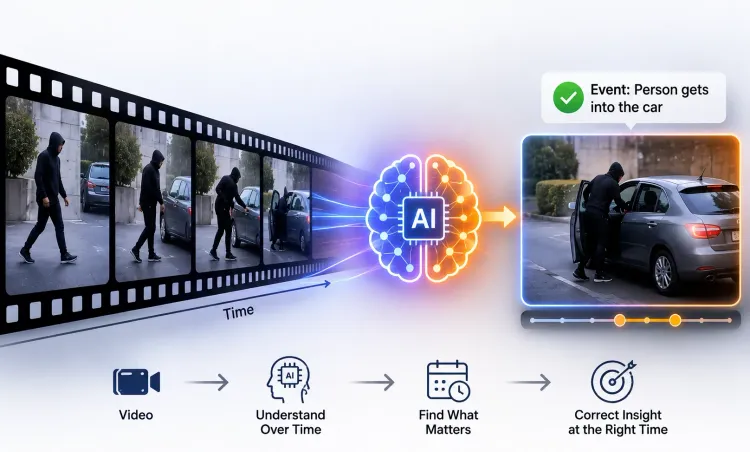
Object tracking is an important component of intelligent video analytics because it adds temporal information to object detection.
Detection identifies objects, while tracking estimates how those objects move over time.
Other analysis methods can then use tracking results to identify patterns or evaluate predefined conditions.
For example, a warehouse video analysis workflow might involve:
Detecting forklifts and pedestrians in video frames.
Associating detections across frames.
Maintaining tracking IDs and movement trajectories.
Analyzing whether tracked objects enter specified zones.
Reviewing the resulting information to understand movement patterns.
More advanced systems may combine tracking with event recognition, scene understanding, or other AI methods.
Tracking by itself does not establish why an object moved or whether a particular activity is unsafe.
For a deeper discussion of temporal video analysis, explore Prexable's article on understanding events beyond object tracking.
Frequently Asked Questions About Object Tracking
What is object tracking in simple terms?
Object tracking is the process of following an object as it moves through a video.
A tracking system estimates where the object appears in each frame and attempts to maintain the same identity over time.
What is the difference between object detection and object tracking?
Object detection identifies and locates objects within individual images or video frames.
Object tracking connects observations across frames to estimate how objects move and maintain their identities.
What is multi-object tracking?
Multi-object tracking is the process of following multiple objects simultaneously while attempting to preserve a separate identity for each object.
It is commonly used in video analysis applications involving people, vehicles, and other moving targets.
Does object tracking require artificial intelligence?
Not necessarily.
Traditional object tracking methods can use mathematical motion models, image features, and other computer vision techniques.
Modern tracking systems may also use machine learning and deep learning to improve detection, appearance representation, and data association.
Can object tracking work in real time?
Yes. Some object tracking systems are designed to process video frames as they arrive.
Whether a particular system achieves real-time performance depends on its algorithms, hardware, video resolution, number of objects, and other processing requirements.
What happens when a tracked object disappears?
A tracker may predict the object's location and temporarily maintain its track.
If the object reappears, the system may attempt to associate it with the previous identity.
However, successful reassociation is not guaranteed, especially after long occlusions.
Can object tracking work across multiple cameras?
Yes, but cross-camera tracking requires additional methods to associate observations from different camera views.
Differences in lighting, camera angles, object appearance, and timing can make this challenging.
What are the most common object tracking algorithms?
Commonly studied tracking approaches include SORT, DeepSORT, ByteTrack, and BoT-SORT.
These methods differ in how they use motion prediction, object appearance, detection confidence, and data association.
Is object tracking the same as object recognition?
No.
Object tracking estimates where an object moves and attempts to preserve its identity within a tracking sequence.
Object recognition identifies or classifies objects based on their visual characteristics.
A system may combine recognition and tracking, but they are distinct tasks.
What are the main limitations of object tracking?
Common limitations include occlusion, identity switches, poor image quality, similar-looking objects, crowded scenes, camera movement, and computational requirements.
The severity of these challenges depends on the tracking method and application environment.
Conclusion
Object tracking is a fundamental computer vision technique that enables systems to follow objects across video frames and analyze their movement over time.
By maintaining object identities and trajectories, tracking adds valuable temporal information to object detection.
This makes it useful for applications ranging from warehouse monitoring and transportation analysis to robotics, security, and sports analytics.
However, reliable tracking requires careful consideration of object detection quality, identity association, environmental conditions, and application-specific evaluation.
Understanding how object tracking works, where it performs well, and where it can fail is an important first step toward selecting an appropriate video analysis solution.
Prexable focuses on making custom video AI more accessible through capabilities involving object detection, tracking, and recognition. Explore Prexable to learn more about its approach to video analysis.
Working with video data?
See how Prexable can detect, track and explain what happens in your footage.
Talk to our team