Visual Language Models for Video Analytics
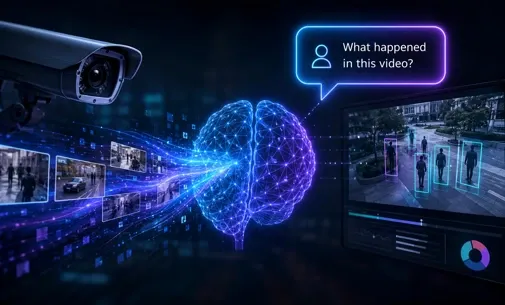
Visual Language Models for Video Analytics: The Next Step Toward AI That Understands Video
For years, video analytics has focused on answering relatively straightforward questions.
Is there a person in the scene? Is there a vehicle? Did someone cross a restricted area? How many people entered the building?
Modern computer vision systems have become remarkably good at these tasks. Object detection, tracking, segmentation, and recognition technologies can process enormous amounts of video with impressive speed and accuracy.
But there has always been a limitation.
Traditional video analytics systems can only answer the questions they were specifically designed to answer.
What happens when a security operator wants to know:
"Did anyone leave a package unattended near the entrance?"
Or when a warehouse manager asks:
"Show me every forklift that entered the pedestrian zone this morning."
These types of questions require more than object detection. They require understanding.
This is where Visual Language Models (VLMs) are changing the game.
What Is a Visual Language Model?
A Visual Language Model combines computer vision with large language models, allowing AI systems to understand both visual information and natural language. Instead of interacting with video through predefined rules and dashboards, users can simply ask questions in plain language.
For example:
- How many people entered the building after 8 PM?
- Is anyone wearing safety equipment?
- What unusual activity occurred in this video?
The system analyzes the visual content, understands the question, and generates an answer.
In many ways, VLMs allow people to interact with video data the same way they interact with modern AI assistants.
Why Traditional Video Analytics Has Limits
Most current video analytics systems follow a structured pipeline:
- Detect objects.
- Classify them.
- Track them across frames.
- Trigger predefined rules.
This approach works extremely well for many applications.
A surveillance system can detect people entering restricted areas. A traffic monitoring system can count vehicles. A manufacturing system can identify defective products.
The challenge is flexibility.
Every new requirement often means creating new rules, training additional models, or building custom software.
As organizations collect larger volumes of video, manually defining every possible scenario becomes increasingly difficult.
VLMs offer a different approach.
Instead of teaching the system every possible question in advance, we teach it how to understand.
From Detection to Understanding
Think about how humans watch video.
When we see footage from a security camera, we don't simply identify objects. We interpret relationships, context, and events.
We understand that a person carrying a ladder toward a restricted area may deserve attention. We recognize when someone appears lost, suspicious, or in need of assistance.
Traditional computer vision excels at identifying what is present.
Visual Language Models begin to address what is happening and why it matters.
That distinction may sound subtle, but it represents one of the most significant shifts in computer vision over the past decade.
Why VLMs Matter for Video Analytics
Organizations today generate more video than humans can realistically review.
Security cameras operate 24/7. Industrial facilities monitor production lines continuously. Drones collect thousands of images during inspections. Smart cities deploy cameras across roads, intersections, and public spaces.
Finding important information within all that footage is often like searching for a needle in a haystack.
Visual Language Models make searching video far more intuitive.
Imagine asking:
- Show me all vehicles that stopped in front of the loading dock.
- Find instances where workers entered without protective helmets.
Instead of scrolling through hours of footage, users receive meaningful answers within seconds.
The Technology Behind the Shift
The rise of Visual Language Models didn't happen overnight.
Several breakthroughs helped make them possible:
- Large language models capable of sophisticated reasoning
- Vision transformers that improved visual understanding
- Foundation models trained on massive datasets
- Advances in multi-modal learning
One particularly important development has been the emergence of foundation models for vision.
These models move beyond narrow tasks and provide a broader understanding of visual content.
If you're interested in how foundation models are reshaping video processing, our article From Detection to Understanding: Segment Anything Model 2 (SAM 2) explores another major step toward more intelligent visual systems.
Together, these technologies are pushing computer vision beyond recognition and toward genuine scene understanding.
Real-World Applications
Agriculture and Environmental Monitoring
As drone imagery becomes more common in agriculture, VLMs may help users analyze field conditions without requiring specialized technical expertise.
Farm managers could ask:
- Which areas show signs of crop stress?
- Where are weeds spreading?
- What changes occurred compared to last week's survey?
This makes advanced image analysis accessible to a broader audience.
Intelligent Surveillance
Security teams spend enormous amounts of time reviewing footage.
VLMs can help by enabling natural-language searches across video archives.
Rather than reviewing hours of recordings, operators can ask:
- Who entered the restricted area after midnight?
- Did anyone leave an object unattended?
- Show all vehicles parked in prohibited zones.
The result is faster investigations and more efficient monitoring.
Manufacturing and Industrial Operations
Manufacturing facilities already use AI to detect defects and monitor production processes.
Visual Language Models add another layer of intelligence.
Engineers can ask:
- Which products failed inspection because of surface damage?
- What changed before the defect rate increased?
- Identify all stations where safety procedures were not followed.
Instead of simply generating alerts, the system can provide explanations and context.
Retail Analytics
Retailers increasingly rely on video analytics to understand customer behavior.
A VLM-powered system can answer questions such as:
- Which displays attracted the most attention?
- Where did customer congestion occur?
- Which shelves were frequently empty?
This helps transform video footage into actionable business insights.
Smart Cities
Urban infrastructure generates vast amounts of visual data.
Visual Language Models could help city operators investigate traffic incidents, identify safety concerns, and understand patterns across multiple camera networks using simple language queries.
Rather than searching manually, operators can focus on decision-making.
Challenges That Still Remain
Despite the excitement surrounding VLMs, the technology is not perfect.
Hallucinations
Like large language models, VLMs can occasionally generate incorrect answers while sounding confident.
For critical applications, human review remains essential.
Long Video Understanding
Understanding a single image is relatively straightforward.
Understanding several hours of video while maintaining awareness of events, timelines, and relationships remains a difficult research problem.
Many of today's systems still struggle with very long video sequences.
Computational Requirements
VLMs are significantly more demanding than traditional detection models.
Running these systems in real time requires substantial computing resources, especially when analyzing multiple video streams simultaneously.
As hardware improves, this limitation will become less significant, but it remains an important consideration today.
Privacy Concerns
As AI systems become better at understanding people, activities, and behaviors, privacy becomes increasingly important.
Organizations must balance the benefits of advanced analytics with responsible data handling and regulatory compliance.
Techniques such as federated learning are becoming increasingly valuable because they allow organizations to improve AI models without centralizing sensitive video data. If you’re interested see How Federated Learning is Transforming Privacy-Preserving Video Analytics on the Edge.
What Comes Next?
The future of video analytics is likely to become increasingly conversational.
Instead of building separate systems for detection, search, reporting, and investigation, organizations may interact with a single AI assistant capable of understanding visual information directly.
Users will ask questions.
The system will analyze video.
Answers, summaries, reports, and recommendations will be generated automatically.
We're already beginning to see the early stages of this transition.
Over the next few years, Visual Language Models will likely become a core component of surveillance systems, industrial monitoring platforms, autonomous systems, healthcare applications, and countless other video-driven solutions.
Final Thoughts
Computer vision has spent decades learning how to see.
Visual Language Models represent the next stage: learning how to understand.
Rather than simply identifying objects, these systems can interpret scenes, answer questions, summarize events, and help people extract meaningful insights from enormous volumes of video data.
The technology is still evolving, and important challenges remain. Yet the direction is becoming increasingly clear.
The future of video analytics will not be defined solely by better detection models or more accurate tracking systems.
It will be defined by AI systems that can understand visual information, communicate naturally with humans, and turn raw video into actionable knowledge.
Visual Language Models are one of the most promising steps toward that future.