From Tracking Objects to Understanding Events: The Rise of Temporal Video AI
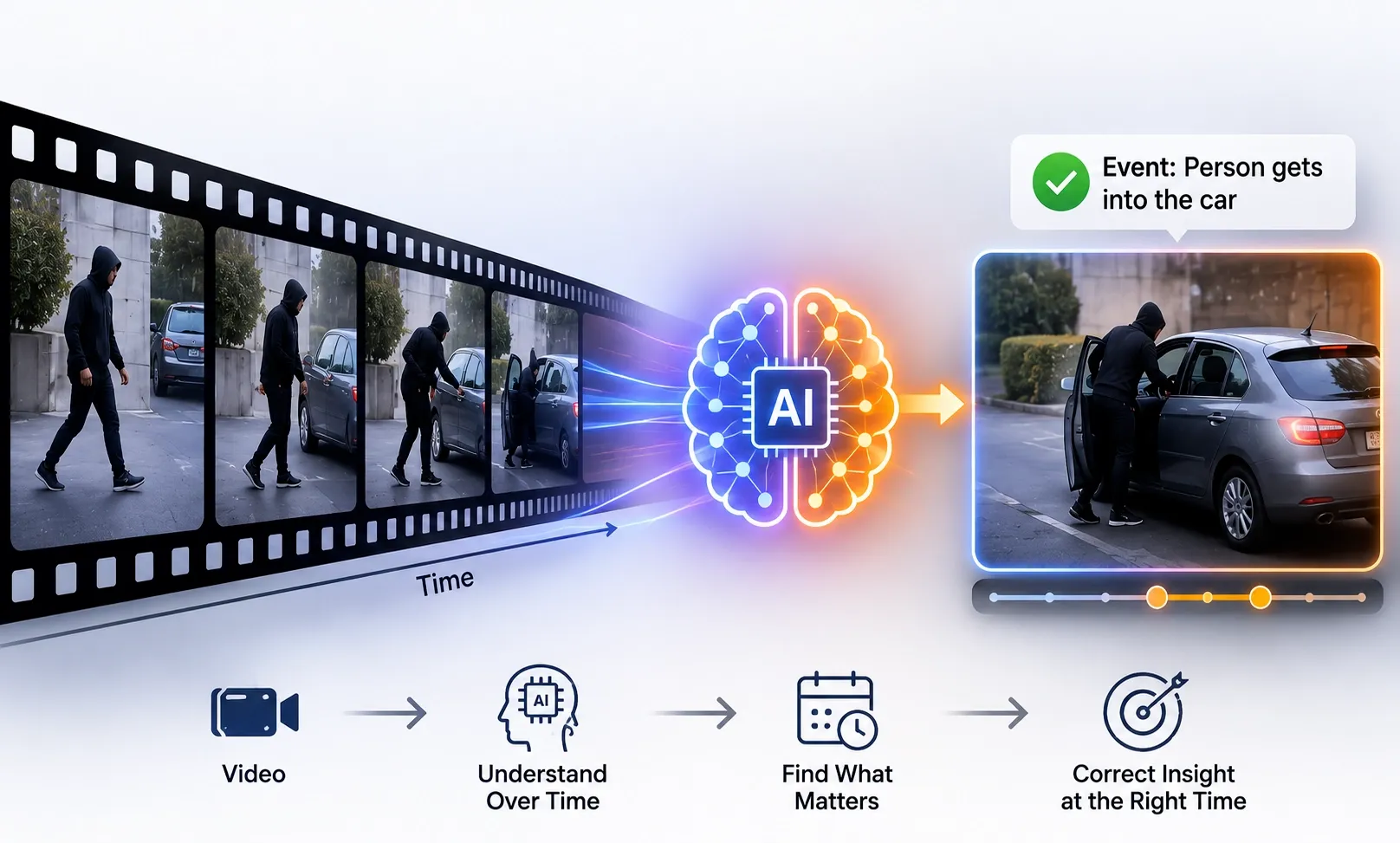
For years, video analytics has focused on identifying objects and following their movement through a scene. Modern computer vision systems can detect people, vehicles, and other objects, recognize identities, and track them across video frames. These capabilities have become the foundation of many applications in security, transportation, industrial monitoring, and other areas. However, identifying objects and tracking their movement is only one part of understanding a video. A video is not simply a collection of independent images. Its meaning often comes from how the scene changes over time, how actions are connected, and how one event leads to another.
From Frames to Sequences
An image captures a single moment, while a video provides a sequence of moments. Some computer vision pipelines often process this sequence by detecting objects in individual frames and then connecting those detections through tracking. This approach provides valuable information about what is present in a scene and where objects are moving, but in some scenarios it does not explain what that movement means.
Temporal video AI is based on the idea that time itself should be part of the model's understanding. Instead of treating each frame as an isolated observation, temporal models attempt to learn relationships between frames and identify patterns that emerge across a sequence. This allows AI systems to move from recognizing individual objects toward understanding actions, interactions, and events.
Why Tracking Alone Is Not Always Enough
Object tracking remains an essential component of modern video analytics, but a trajectory by itself contains limited semantic information. A tracking system can determine where an object was located, how quickly it moved, and how its position changed over time. It does not necessarily understand the significance of that movement or how it relates to other events in the scene.
This distinction becomes particularly important in complex environments. The meaning of an observation can depend on what happened before it, what happens afterward, and how multiple objects interact. As a result, the next generation of video AI needs to combine object-level information with temporal context.
Modern foundation models are already helping extend the capabilities of video analysis. Here we discussed how newer vision models can maintain object information across frames and improve video annotation and tracking workflows. Temporal video AI builds on these capabilities by using the sequence itself as a source of information for higher-level reasoning.
Understanding Actions and Events
One of the main goals of temporal video AI is to recognize actions and events rather than only individual objects. An action can extend across multiple frames, while a larger event may consist of several actions occurring in a particular order. Recognizing these patterns requires a model to understand not only what is visible at a particular moment, but also how the visual state of the scene changes over time.
This makes temporal reasoning significantly more challenging than conventional image recognition. The meaning of one frame may depend on information that appeared several seconds earlier, while some important events may only become clear after several subsequent frames have been observed. A capable temporal model therefore needs to preserve relevant context while determining which changes in the scene are meaningful.
The Challenge of Long-Video Understanding
Temporal reasoning becomes even more difficult when AI systems are expected to analyze long videos. Processing a short clip is relatively manageable, but real-world applications can involve hours of continuous footage. Examining every frame with a large model can be computationally expensive, while sampling too aggressively can cause important information to be missed.
For this reason, recent research is exploring more efficient ways to search and reason over long videos. Instead of processing every moment with the same level of detail, newer approaches can identify potentially relevant temporal segments and then perform more focused analysis. Recent work on long-video understanding has explored hierarchical and reasoning-guided methods for locating useful sections of lengthy video content.
This shift is important for practical video analytics because real-world systems rarely operate on short, perfectly selected clips. They must deal with large volumes of continuous visual data and determine which parts contain meaningful information.
Temporal Grounding: Finding When Something Happened
Understanding an event is only useful if a system can also determine when it occurred. Temporal grounding addresses this problem by connecting a description, action, or natural-language query to a specific interval in a video.
Instead of returning only a general interpretation of an entire recording, a temporal system can identify the relevant section of the timeline. This makes video easier to search and allows users to move directly to moments that matter. Recent research is extending temporal grounding to long videos containing multiple relevant intervals, making it possible to associate a query with several separate moments when necessary.
This capability could become particularly valuable as organizations accumulate increasingly large video archives. Rather than manually reviewing recordings, users could search for activities and receive the corresponding moments automatically.
The Role of Multimodal AI
Temporal reasoning is also becoming closely connected with multimodal models. Vision-language models can combine visual information with natural language, allowing people to interact with video using questions and descriptions instead of relying entirely on predefined categories.
Here we looked at this transition and the growing role of multimodal models in video analysis. When multimodal capabilities are combined with temporal reasoning, a system can begin to connect visual events with language and interpret activities across time rather than simply returning frame-level detections.
This creates a more flexible form of video analysis. Instead of asking a system only to detect known objects, users can increasingly describe what they are looking for and expect the system to locate and interpret the relevant parts of the video.
Applications of Temporal Video AI
The value of temporal understanding becomes clear in situations where the meaning of a scene depends on the sequence of events. In security and surveillance, temporal models can help distinguish isolated detections from meaningful activities. In industrial environments, they can analyze processes where the order and duration of actions are important. In sports, temporal reasoning can help interpret interactions and sequences that cannot be fully described by player positions alone. Similar capabilities are also relevant to robotics and autonomous systems, where understanding how an environment changes over time is essential for decision-making.
Across these applications, the underlying goal is the same: transform raw video into a structured understanding of what happened rather than stopping at object detection and tracking.
Challenges Ahead
Despite rapid progress, temporal video understanding remains an active research problem. Computational cost is one of the main challenges, particularly when systems need to maintain context over long periods of time. Long-range dependencies are also difficult to model because important events may be separated by large amounts of irrelevant visual information.
Maintaining consistent identities and context is another challenge. Objects can become occluded, change appearance, leave and re-enter a scene, or interact with other objects. A system that loses track of these relationships may fail to correctly interpret the larger event.
There is also an important question around trust and interpretability. As video AI systems move toward more complex forms of reasoning, users will need more than a final prediction. They may also need to understand which parts of the video influenced the decision and why a particular sequence was interpreted as a meaningful event.
This is where temporal video AI can connect naturally with Explainable AI. Future systems could provide explanations that identify relevant frames, regions, actions, and temporal relationships instead of presenting only a final classification or alert.
From Video Analytics to Video Understanding
The evolution of video AI can be viewed as a gradual expansion of what machines are expected to understand. Early systems focused on detecting objects. Tracking added continuity across frames. Temporal models introduced actions, context, and relationships between events, while multimodal systems added natural-language interaction and more flexible forms of reasoning.
Together, these technologies are moving video analytics toward a broader goal: understanding what happens in a video rather than simply identifying what appears in it.
As temporal reasoning becomes more capable and efficient, video systems will increasingly be able to search, interpret, summarize, and eventually explain complex activities across long periods of time. The future of video AI is therefore not only about seeing more objects. It is about understanding what those objects are doing, how events are connected, and what the sequence of a video actually means.