Visual Prompting: The Next Interface for Computer Vision
Visual Prompting: The Next Interface for Computer Vision
Computer vision has traditionally been built around specialized models. If you wanted to detect objects, you trained an object detector. If you needed semantic segmentation, you trained a segmentation model. Image classification required another architecture altogether. Every new task often meant collecting more labeled data, training another model, and maintaining another deployment pipeline.
Today, that workflow is beginning to change.
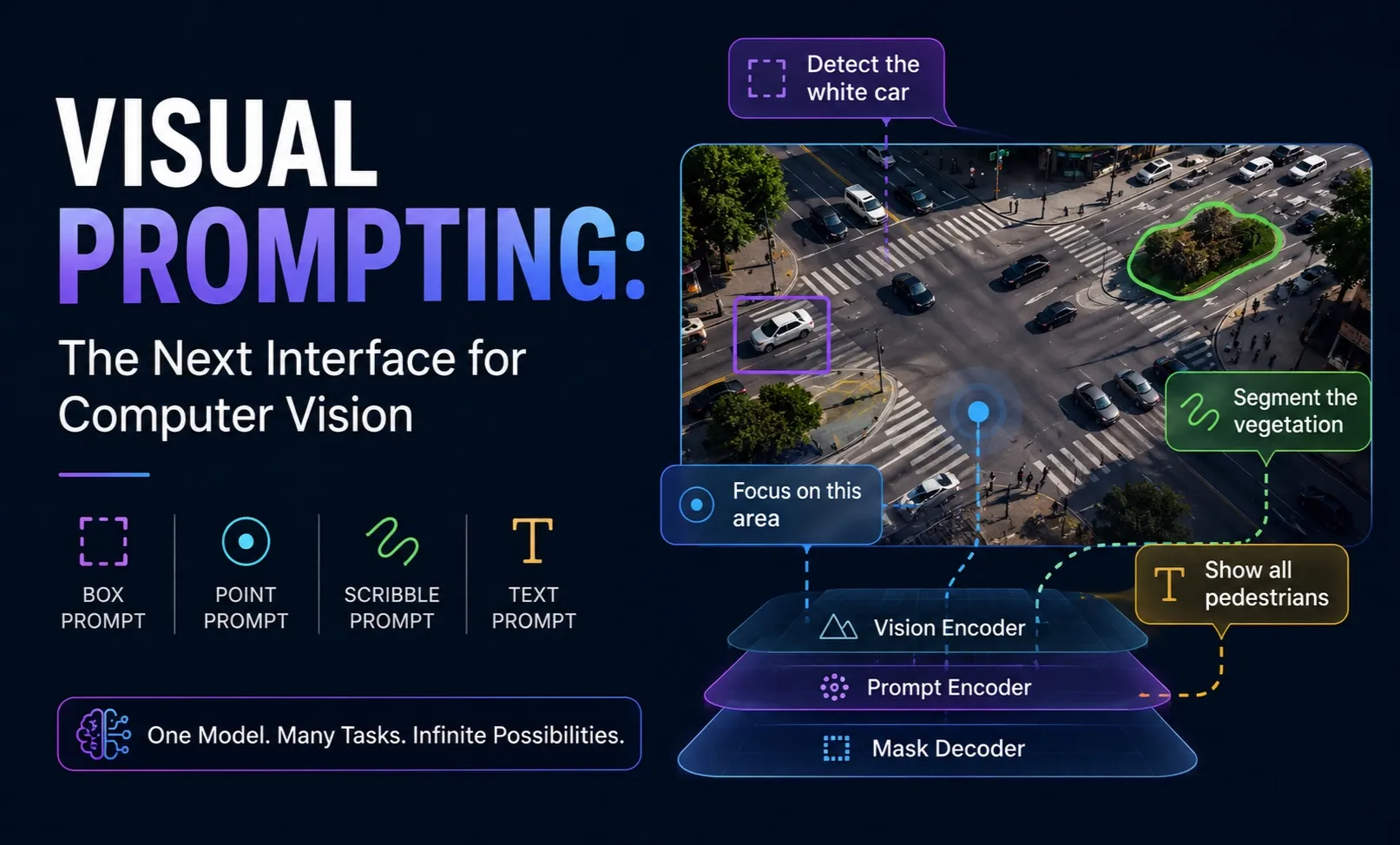
With the rise of foundation models, computer vision is becoming more interactive. Instead of building a model specifically for every use case, users can guide a general-purpose model using prompts. Whether it's a point, a bounding box, a rough sketch, or a text description, the model can interpret the prompt and perform the requested task. This emerging paradigm is known as visual prompting, and it is reshaping how developers and researchers interact with AI-powered vision systems.
From Task-Specific Models to Promptable AI
For years, computer vision systems followed a predictable pipeline. A dataset was collected, annotations were created, a model was trained for a specific objective, and the final system performed only that predefined task.
While this approach has been highly successful, it also comes with limitations. Training separate models for every object category or application requires significant time, computational resources, and labeled data. Even small changes in project requirements may require retraining or fine-tuning.
Visual prompting offers a different perspective.
Instead of asking "Which model should I train?", developers can now ask "How can I describe what I want the model to find?"
This shift transforms the interaction between humans and computer vision systems from model-centric to prompt-centric.
What Is Visual Prompting?
Visual prompting is the process of providing additional information that guides a computer vision model toward a desired output.
Unlike traditional models that always perform the same predefined task, promptable models adapt their predictions based on the user's input. These prompts can take several forms:
- Point prompts to identify a specific object or region.
- Bounding box prompts to focus on an area of interest.
- Scribbles or masks to refine segmentation boundaries.
- Text prompts describing objects, scenes, or concepts.
Each prompt supplies context that helps the model understand what the user is interested in, making the interaction more flexible and intuitive.
Instead of retraining a model to recognize a new object, users can often achieve satisfactory results simply by changing the prompt.
Foundation Models Are Making This Possible
Visual prompting has become practical thanks to the rapid development of vision foundation models.
These models are trained on massive datasets containing millions, or even billions, of images. Rather than learning a single task, they develop broad visual representations that generalize across many scenarios.
When combined with prompts, these representations enable a single model to perform detection, segmentation, localization, and even visual reasoning.
One of the most influential examples is Segment Anything Model 2 (SAM 2). Rather than requiring a fully trained segmentation model for every application, SAM 2 allows users to guide segmentation through simple prompts such as clicks or bounding boxes. This interactive approach dramatically reduces manual effort while improving flexibility.
Beyond Images: Combining Vision and Language
Visual prompting becomes even more powerful when language enters the picture.
Modern Visual Language Models (VLMs) can understand both images and natural language, enabling users to interact with AI in a much more natural way.
Instead of selecting points or drawing boxes, a user can simply ask questions such as:
- Highlight every damaged solar panel.
- Locate all pedestrians crossing the road.
- Segment the cotton plants in this aerial image.
- Which vehicles are parked illegally?
This ability moves computer vision beyond simple detection and toward semantic understanding.
Rather than responding only to pixels, AI systems begin responding to human intent.
Real-World Applications
Visual prompting is already finding applications across numerous industries.
Medical Imaging
Radiologists can guide AI systems toward suspicious regions instead of relying solely on automated predictions. This creates a collaborative workflow where AI assists experts rather than replacing them.
Agriculture
Drone imagery often contains complex scenes with overlapping crops, weeds, and varying lighting conditions. Instead of training separate models for every crop type, promptable systems allow users to identify specific plants or regions of interest through simple interactions.
Industrial Inspection
Manufacturers can quickly inspect defects, cracks, corrosion, or damaged components without developing a dedicated model for every product line.
Robotics
Autonomous robots benefit from promptable perception by adapting to changing environments. Rather than recognizing only predefined objects, they can identify new targets based on operator instructions.
Why Visual Prompting Matters
The growing popularity of visual prompting is driven by several practical advantages.
First, it improves flexibility. A single foundation model can support multiple tasks without maintaining separate AI systems.
Second, it reduces development time. Teams can prototype new applications much faster because they rely on prompts instead of collecting thousands of additional annotations.
Third, it creates more interactive workflows. Users remain part of the decision-making process by guiding the model rather than accepting fully automated predictions.
Finally, visual prompting lowers the barrier to entry for organizations that lack large annotated datasets, making advanced computer vision more accessible across different industries.
Current Challenges
Despite its promise, visual prompting is not a universal solution.
The quality of the output depends heavily on the quality of the prompt. Ambiguous prompts often produce ambiguous predictions, especially in crowded or visually complex scenes.
Performance can also vary across specialized domains where foundation models have limited prior knowledge. In safety-critical applications such as autonomous driving or medical diagnosis, carefully trained task-specific models may still provide more predictable and consistent results.
Another consideration is computational cost. Large foundation models often require significantly more memory and processing power than traditional lightweight detectors, making deployment on edge devices more challenging.
The Future of Computer Vision
The evolution of computer vision is shifting from building increasingly specialized models toward developing more general and adaptable AI systems.
In the coming years, developers may spend less time training new models and more time designing effective prompts, integrating multi-modal inputs, and creating intelligent workflows around foundation models.
This does not mean traditional object detectors and segmentation models will disappear. They will continue to play an essential role in applications requiring high speed, low latency, or domain-specific optimization.
However, visual prompting introduces a new layer of flexibility that was previously difficult to achieve. Instead of asking AI to solve only one predefined problem, we are beginning to ask it to understand our intent and adapt accordingly.
Final Thoughts
Visual prompting represents more than another advancement in computer vision, it changes how humans communicate with AI systems.
By combining foundation models with intuitive prompts, developers can build applications that are more adaptable, interactive, and easier to deploy across a wide range of real-world scenarios.
As research continues to connect visual prompting with multi-modal reasoning, agentic AI, and explainable decision-making, it is becoming increasingly clear that prompts are evolving into the primary interface between humans and intelligent vision systems.
For developers and researchers alike, understanding visual prompting today is not just about learning a new technique, it is about preparing for the next generation of computer vision.