From Detection to Understanding
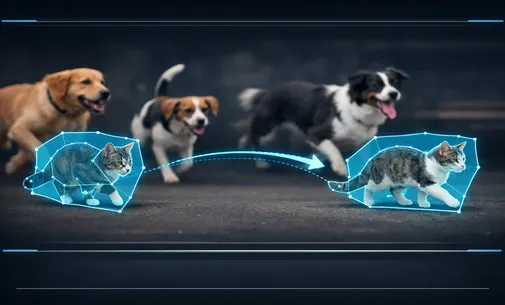
From Detection to Understanding: How “Segment Anything 2” Is Redefining Video Annotation and Tracking
For years, video AI pipelines have followed a familiar pattern: detect objects, track them across frames, and manually refine annotations. However, in 2025 and beyond, this pipeline is undergoing a fundamental shift.
A new class of foundation models for vision, such as Segment Anything Model 2 (SAM 2), is transforming how video understanding is approached, moving from model-specific pipelines to general-purpose visual intelligence.
This article explores how this shift is changing object tracking, annotation, and explainabilitym, and why it matters for modern video AI systems.
The Shift: From Task-Specific Models to Foundation Models
Traditional pipelines typically consist of separate stages: detection (e.g., YOLO, DETR), tracking (DeepSORT, ByteTrack), and annotation, often manual or semi-automated.
In contrast, the new paradigm consolidates these capabilities into a single system. A foundation model can simultaneously handle segmentation, tracking, annotation assistance, and even interaction through prompts.
SAM 2 exemplifies this transition. It can segment arbitrary objects in both images and videos, track them consistently across frames, and operate using simple user prompts such as clicks or bounding boxes, without requiring retraining.
In practical terms, annotation, tracking, and segmentation are no longer separate processes; they are converging into a unified system.
What Makes SAM 2 Different?
1. Promptable Video Understanding
Instead of being trained on fixed categories, the model responds dynamically to user input. A simple click can trigger segmentation, and the system generalizes effectively to unseen object classes.
2. Temporal Consistency (Built-in Tracking)
Once an object is selected, it is automatically followed across frames. This eliminates the need for a separate tracking module.
3. Streaming Memory Architecture
The model maintains temporal context, allowing it to handle occlusions, motion, and appearance changes more robustly. This is critical because video is not just a sequence of independent images, but a continuous temporal signal.
Why This Matters for Annotation
In traditional workflows, annotation is labor-intensive: annotators label frames one by one, fix inconsistencies, and often repeat the process after retraining models.
With SAM-like systems, the workflow becomes significantly more efficient. A user annotates an object once, the annotation propagates across frames, and only edge cases require correction.
The result is clear:
- Faster dataset creation
- Lower labeling cost
- More consistent annotations
For further context on evolving annotation workflows, see “The Future is Now: Leveraging AI for Real-Time Video Annotation”.
Impact on Object Tracking
SAM 2 introduces a shift in how tracking is conceptualized. Instead of relying on explicit object IDs and bounding boxes, it enables tracking through fine-grained segmentation masks.
This reframes the problem. Tracking is no longer just about locating an object, it becomes about understanding its precise shape and extent at the pixel level over time.
Explainability: A Hidden Advantage
Segmentation-based approaches provide stronger interpretability. The exact regions influencing predictions are visible, making it easier to construct visual counterfactuals and diagnose errors.
Compared to bounding-box outputs, this leads to more transparent and analyzable model behavior. It also aligns with broader discussions on bias and failure modes in video AI systems, such as “When AI Sees Wrong: Common Pitfalls & Biases in Video Analytics”.
Real-World Use Cases
These capabilities translate into tangible improvements across multiple domains. In autonomous systems, precise object boundaries contribute directly to safety. In medical imaging, consistent segmentation across temporal scans improves reliability.
Applications in video editing and augmented reality benefit from real-time object selection and manipulation, while data annotation platforms see substantial productivity gains and more scalable human-in-the-loop workflows.
Challenges
Despite their strengths, SAM-like models are not without limitations:
- Dependence on user prompts
- Difficulty in complex scenes with visually similar objects
- Limited semantic understanding (distinguishing “what” vs. “where”)
Ongoing research is addressing these gaps through approaches such as text-guided segmentation, self-prompting systems, and hybrid detection–segmentation models.
Conclusion
A new paradigm is emerging in video AI: the transition from multi-stage pipelines to unified foundation models.
Rather than combining multiple specialized components, a single model can now handle segmentation, tracking, and even aspects of interpretation. This shift enables faster annotation workflows, built-in explainability, and more natural human–AI interaction.
The next generation of video AI systems will not simply process video, they will interact with it.
Reference
If interested, you can read also a key paper behind this shift:
- “SAM 2: Segment Anything in Images and Videos” (Meta AI, 2024), this paper:
- Introduces a transformer with streaming memory for video segmentation
- Achieves strong performance with fewer interactions